
Barnstable 72-Hour Feed Status
No official Barnstable County Sheriff page lists releases from the past three days. The agency has no live public jail roster, recent-release view, or 72-hour filter. It also does not advertise a mobile inmate-search app. The three-day window must therefore be built from dated agency and court records, not read from a single page.
This matters when a custody change crosses a weekend, holiday, or court-processing period. A Friday court order, Saturday facility exit, and Monday records response can all describe the same case from different points in the process. Treat each time stamp as evidence of its own event. The legal order and physical release are related but not always simultaneous.
The absence of a live list also means there is no Sheriff-published rule for how long a recent release would stay visible. Do not assume a three-day retention period. Preserve the response from BCSO, the date of the facility call, and the docket entry that falls within the selected window.
Build Barnstable’s Three-Day Window
Start with a clear beginning and end date. Then identify which custody layer held the person. Cape police departments operate short-term lockups. BCCF is the county jail and house of correction. MA DOC, BOP, and ICE are separate systems. A person may move between them during the 72 hours.
- Call BCCF at 508-563-4300 for current facility status and note the time of the call.
- Ask BCSO Records at 508-563-4371 for release transactions dated within the exact range.
- Review the criminal docket for bail, recognizance, dismissal, sentence, probation, warrant, or transfer entries.
- Check a named receiving agency when BCSO records show a transfer instead of community release.
- Save the quarter’s later Chapter 126 filing as retrospective support when it becomes available.
For one named person, identifiers matter more than a loose date search. Provide the booking date, docket number, PCF, SID, or OBTN if known. Those details keep a common name from being matched to the wrong custody episode. The Barnstable County released-inmate search connects a named-person check across county, court, state, and federal systems.
Barnstable Three-Day Record Fields
A useful Barnstable County 72-hour reconstruction should show more than a name and date. The reason and destination determine whether the person returned to the community or merely left BCSO custody. Request fields that can be matched across the Sheriff record and court docket.
| Field | How it helps |
|---|---|
| Full name and identifiers | Ties the result to the correct person and booking. |
| Booking date | Separates the recent admission from older Barnstable records. |
| Release date and time | Places the BCSO exit inside or outside the 72-hour span. |
| Release authority | Explains bail, court order, expiration, parole, transfer, or another type. |
| Destination | Distinguishes community release from continued custody elsewhere. |
| Docket or OBTN | Supports comparison with the judicial case and quarterly filing. |
The public quarterly table later adds PCF and SID identifiers, race and ethnicity, admission type, earned jail credit, time in days, and sentence length. It does not always state a plain-language destination, so the underlying BCSO transaction may still be needed.
Note: A blank quarterly release date does not prove ongoing custody after the report cutoff and should not be read that way.
Barnstable Weekend Release Checks
A 72-hour span is useful because courts, police, and facilities create records on different clocks. A person can receive a release order before staff complete all custody steps. Conversely, a police-lockup release may occur without admission to BCCF. The arresting department’s log and bail papers become central in that case.
Most public Massachusetts criminal cases are remotely searchable by exact docket number. If a weekend event is hard to trace, identify the right division from the arresting town and charge level, then obtain the number from case papers, the police record, or the criminal clerk. Barnstable, Falmouth, and Orleans District Courts divide the Cape towns, while Superior Court serves the county.
Read the docket in sequence. Look for bail or personal-recognizance orders, mittimus entries, dismissal, sentence, probation, and warrants. A mittimus is the court’s order committing a person to custody. The clerk’s certified docket is stronger proof of court action than a search-screen summary.
Read Barnstable Release Types
The state’s release taxonomy helps interpret a three-day Barnstable County chronology. A release event records departure from the reporting agency. It does not always describe freedom from all custody. The authority and destination must be read with the date, especially when several agencies appear during one weekend.
| Release type | Meaning within the 72-hour review |
|---|---|
| Bail | The person left under a financial release order, subject to the court case. |
| Personal recognizance | The person was released on a promise to appear without posting money. |
| Court release | A judicial event such as a stayed, revoked, or vacated sentence caused the exit. |
| Expiration | The custodial term reached its lawful end. |
| Parole | The person entered community supervision under Parole Board jurisdiction. |
| Another agency | BCCF custody ended, but a sheriff, DOC, federal, immigration, or other authority received the person. |
A dismissal on the docket can explain why custody should end, yet the actual BCSO transaction remains the better source for the physical exit date. Likewise, a parole grant is a Board decision, not proof of the gate time. Release processing, a warrant, or another prerequisite may still affect the departure.
Quarterly data may use reporting categories rather than the exact words found on an individual record. Ask BCSO for the underlying release type and destination when a row is unclear. That detail is critical when one agency’s “release” becomes another agency’s admission inside the same 72-hour span.
Deaths are also counted as release events in the state taxonomy. That category is plainly not a community release. Its inclusion is another reason to read the type instead of treating a dated departure row as a list of people who returned home.
Barnstable’s Durable Release Archive
The Barnstable Chapter 126 quarterly report is a delayed legislative filing with exact person-level release fields. It is the most durable public Sheriff release source found in the research, yet it cannot identify who left during the current 72 hours. Use it after publication to verify an older event or anchor a later records request.
The official legislative report landing page provides a stable provenance trail for Barnstable’s quarterly filing.
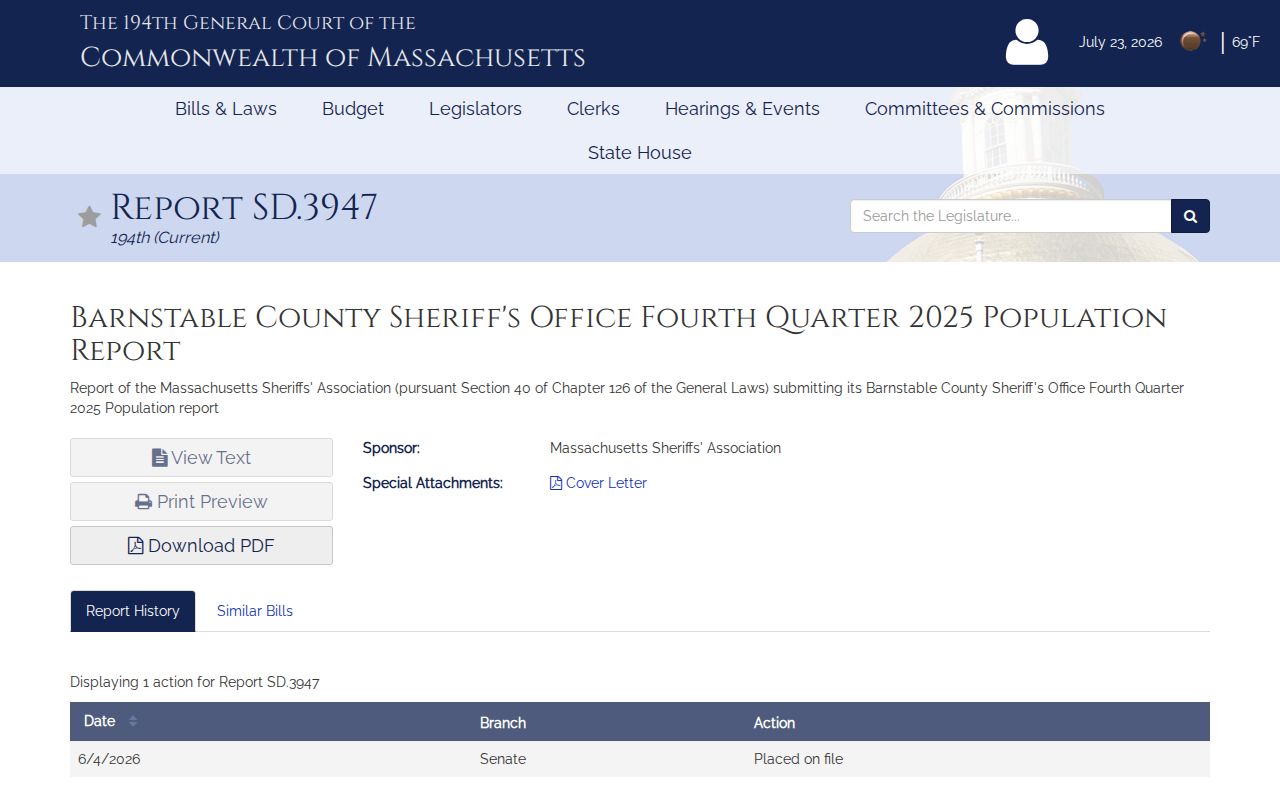
The landing page identifies the filing source and quarter, which should remain attached to any cited release row.
The separate Cross-Tracking dashboard can show Barnstable agency release-event counts by year, month, and release type. Those totals help explain patterns, but they do not name released people. Never use an aggregate count to infer an individual’s status.
Keep the report’s quarter, filing page, and row identifiers together. Later reports are separate records rather than updates to one continuous list. If a release date is blank, compare the next quarter and request the transaction instead of extending the 72-hour window by guesswork.
Confirm Barnstable Release Status
Two independent records are best when the legal distinction matters. The BCSO record confirms that Barnstable custody ended. The court docket explains the judicial event. If the Sheriff lists another agency as destination, the receiving system determines whether custody continued.
| Custody layer | Correct check |
|---|---|
| BCCF | Facility line, BCSO Records, and Chapter 126 report. |
| Municipal police lockup | Police log, department records officer, bail papers, and court docket. |
| MA DOC | VINE for reported current custody, then DOC records for a past discharge. |
| Federal prison | BOP Inmate Locator and the federal court record. |
| Immigration custody | ICE Online Detainee Locator or ERO contact. |
Massachusetts VINE covers MA DOC, not BCCF. A no-match there cannot confirm a Barnstable County jail release. BOP’s “Released” or “Not in BOP Custody” result proves only departure from BOP, not freedom from every agency.
Request Barnstable Three-Day Records
Send a narrow written request through the BCSO Records Access Officer. State the exact 72-hour range, person, booking date, and known identifier. Ask for the booking/admission and release transaction, actual release date and time, release type, and destination agency. Writing is advised because it creates a precise record of the scope.
Massachusetts public-record law requires production or a written response within ten business days when a request reasonably describes records in the agency’s custody and lawful fees are paid. Some portions may be withheld under privacy, CORI, security, victim, juvenile, or other exemptions. Ask for segregable nonexempt fields and electronic delivery.
A true same-day question is narrower than this three-day workflow. The Barnstable County 24-Hour Releases page focuses on today’s direct facility and records check. Neither route creates a public feed that BCSO does not provide.
Note: Keep the date, time zone, office contacted, and response time with each record so the three-day chronology remains clear.