
Barnstable Parole and Probation Compared
Parole and probation can both place a person in the community under conditions, but the legal source is different. The Massachusetts Parole Board grants a parole permit to an eligible person serving a state or qualifying house-of-correction sentence. The person remains under Board jurisdiction. A judge orders probation as part of a criminal disposition, sometimes without a prison term and sometimes after incarceration.
| Question | Parole | Probation |
|---|---|---|
| Who creates it? | Massachusetts Parole Board | Sentencing court |
| Who supervises it? | Parole Board field supervision | Massachusetts Probation Service at the court |
| Best record | Permit, authorized Board record, or public life decision | Criminal docket and court probation record |
| How it ends | Sentence end or early termination certificate | Court-ordered completion or discharge |
Neither status is the same as unconditional sentence discharge. A person can be released from confinement and still owe supervision. Conversely, a person who left BCCF on bail may have a pending case but no parole or probation order yet.
- Parole
- Conditional release from confinement under Board jurisdiction.
- Probation
- Court-ordered community supervision tied to a criminal case.
- Discharge
- The documented end of the sentence or supervision obligation.
- Absconder
- A person alleged to have stopped reporting or left supervision without permission.
Verify Barnstable Post-Release Supervision
Massachusetts does not provide one public name search for all supervised people. Verification starts with the case and release path. A public life-sentence decision can establish a Board outcome, but most individual parole records require authorization or a case-specific public-record review. Probation is confirmed in the docket and through the Probation Department serving the court.
- Identify the court division, docket number, and whether the person served a county or state sentence.
- Read the docket for a probation order, sentence structure, and later disposition.
- For parole, check the Board's records and hearings guidance and any public life-sentence decision.
- Contact the Board with authorization or a focused request for nonexempt status information.
- For probation, contact the Probation Department of Barnstable, Falmouth, Orleans, or Superior Court as the docket directs.
- Ask for the start, current status, supervising office, end date, and discharge record rather than assuming release equals completion.
The MassCourts portal generally requires an exact docket number for remote criminal searches. When the number is unknown, the correct court clerk or a public courthouse terminal may be the practical route.
Barnstable Supervision Office Routes
The Parole Board is the central contact for parole records and jurisdiction. Research did not identify a public name directory or a single Barnstable parolee lookup. The statewide office can route a records question or explain the authorization process. Probation contacts depend on the court that imposed or now supervises the order.
The Board’s public hours are Monday through Friday from 8:45 a.m. to 5 p.m., and its toll-free number is 866-480-6272. The transitional-services directory also lists an institutional office at Barnstable House of Correction, 6000 Sheriff’s Place in Bourne, at 508-563-4347. That office supports institutional release planning. It is not a public name-search service for people already on parole.
Parole Region 8 is listed at 421 Faunce Corner Road in Dartmouth, with 508-995-6400 extension 3640 and weekday hours from 9 a.m. to 5 p.m. Confirm the correct region with the Board before traveling. An old office address does not prove current assignment, and personal supervision details may not be publicly available.
Barnstable District Court, Falmouth District Court, and Orleans District Court divide the Cape's towns. Barnstable County Superior Court serves the whole county for cases within its jurisdiction. Use the docket heading to avoid asking the wrong probation office. Court staff can explain access and routing, but they do not replace a signed order or certified record.
Barnstable District Court Probation is reached at 508-375-6800 and serves Barnstable, Yarmouth, and Sandwich. Falmouth District Court serves Bourne, Falmouth, and Mashpee, with probation reached through the court’s 508-495-1500 number at extension 234. Orleans District Court serves the Outer and Mid-Cape towns listed in the court routing record. Superior Court handles qualifying countywide felony matters. The docket identifies which office controls the order.
Note: Supervision office assignment can change, so confirm the current office through the Board or the court rather than relying on an old address.
Barnstable Supervision Conditions and Warrants
Conditions vary by order and person. They may include reporting, travel limits, treatment, testing, residence approval, or compliance with other court terms. The authoritative list is the parole permit or probation order. A public summary should not be treated as the person's complete set of conditions.
An alleged violation can lead to a warrant, hearing, revocation, modification, or another court action. “Absconder” is a supervision status, not proof that a new crime occurred. For parole, the Board's revocation process addresses an alleged breach after community release. For probation, the supervising court handles violation proceedings and records the result in the docket.
VINELink is not a public parole or probation directory. Massachusetts VINE covers current MA DOC custody. A person returned to DOC might appear through that custody route, but absence from VINELink does not prove compliant supervision. Use the Board or court record for the legal status.
How Barnstable Supervision Ends
Parole can end when the controlling sentence expires or when the Board issues an authorized early termination certificate. Massachusetts publishes monthly termination-request calendars. Those hearings concern people already on parole who seek an early end to the sentence; they are not release calendars for people still in prison.
Board guidance considers supervision history, current risk and reporting status, recent violations or warrants, open cases, and other compliance factors. M.G.L. c. 127, § 130A supplies certificate authority. A calendar entry shows that a request is scheduled, not that termination was granted.
Probation ends under the supervising court's order. The docket and court probation record provide the strongest evidence of completion, modification, extension, or termination. The underlying Barnstable County release record establishes the custody event, while the supervision discharge establishes that the later community obligation ended.
Barnstable Parole Hearing Records
The Massachusetts parole hearings hub separates institutional release, rescission, revocation, life-sentence, victim-access, and termination hearings. Institutional hearings are generally closed. Central-office hearings are generally open except victim-access matters. These labels describe different stages and should not be collapsed into a single “parole release” result.
The official Board hearing page shown below is the source for distinguishing these Barnstable post-release supervision proceedings.
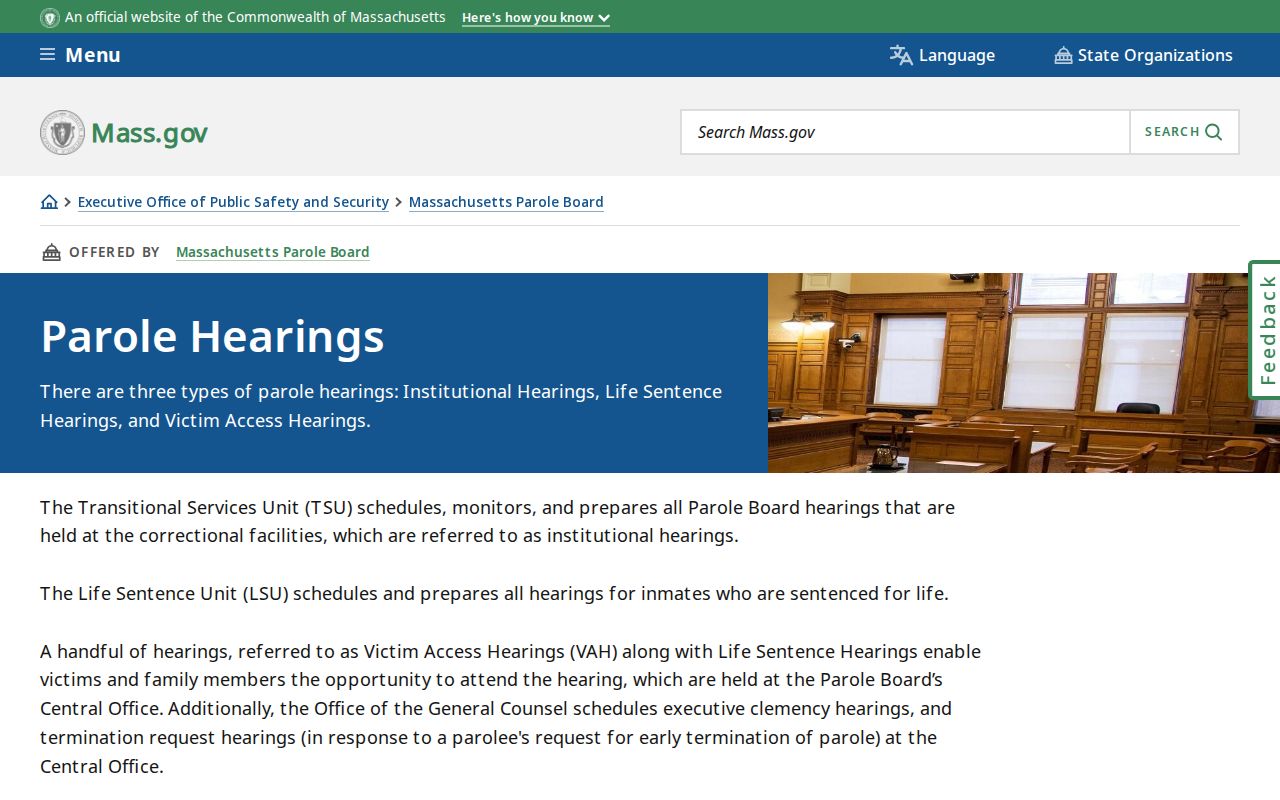
The captured hearing hub shows why a hearing label must be read before treating an entry as a release, violation, or supervision-termination event.
Public life-sentence records of decision commonly state the participants, vote, result, reasons, and review interval, subject to redaction. A grant can authorize a later supervised release, but it is not proof of the physical gate date. Confirm the release through DOC and the Board record.
Termination calendars answer a later question. They concern someone already living on parole who seeks the sentence's early end. The Board's final certificate, not the calendar, is the proof of discharge.
Barnstable Parole Eligibility Records
Eligibility is not the same as a grant or a release. For an ordinary Massachusetts state-prison sentence, M.G.L. c. 127, § 133 generally ties parole eligibility to service of the judicial minimum term, with reductions only where the law permits. Concurrent or consecutive state terms receive a single parole-eligibility calculation. The sentencing court sets minimum and maximum state-prison terms under M.G.L. c. 279, § 24, subject to offense-specific limits.
Mandatory minimums and statutory exclusions can override the ordinary pattern. Life-sentence eligibility follows separate rules under § 133A and the applicable sentencing law. First-degree murder committed by an adult remains outside ordinary parole eligibility, while age, offense date, and sentence type can change other life-sentence questions. Do not estimate a hearing or release date from a generic percentage. Use the mittimus, DOC calculation, Board record, and actual release transaction.
Barnstable Reentry at Bridge Center
The Sheriff's Bridge Center is at the Barnstable court complex, not the remote Bourne jail. BCSO presents it as a navigation point for people with justice-system involvement, including those recently released or under supervision. The location can make service coordination easier for someone who also has court business.
The Bridge Center is at 3195 Main Street in Barnstable Village and is open Monday through Friday from 8 a.m. to 4 p.m. or by appointment. Its published offerings include recovery and health navigation, family support, legal consultations, education pathways, and support groups. Check the current calendar because service schedules can change.
The Bridge Center does not verify parole, probation, or release. Those records still belong to the Board, supervising court, BCSO, or DOC. BCSO also describes six months of E-MAT community follow-up after release through its treatment program. That support is a local reentry layer, not a public supervision roster or a promise of a particular outcome.
Property After Barnstable Release
Release logistics can continue after supervision starts. BCSO creates a debit card for money left in a facility account. The released person may call 508-563-4317 or visit the Sheriff's lobby Monday through Friday, 8 a.m. to 3 p.m., to have Inmate Accounts issue the card. General property questions go to 508-563-4368.
The official account instructions cover this post-release step. Massachusetts retains personal-property records for three years after final release. Account and property records can reconcile what remained at BCCF, but they do not establish whether parole or probation is active.